Last updated: October 6, 2026
NPT (National Pipe Taper) is the standard tapered thread used on US plumbing connections — faucets, valves, and shower fittings — that seals as it tightens; a common residential size is 1/2″ NPT. Note that NPT applies to plumbed fixtures, not to towel bars or hooks, which simply screw to the wall. Here is what NPT means for the bathroom products that actually connect to water.
Key facts
- NPT is defined by ASME B1.20.1: a 60° thread angle on a 1:16 taper (¾ inch of diameter per foot of length) — the taper is what makes the joint wedge tight and seal.
- Sizes are nominal, not actual: a “1/2 inch” NPT male thread measures about 0.84″ (21.3 mm) across — never size a fitting with a ruler.
- Not everything tapered-looking is NPT: hose connections often use straight threads sealed by a washer, and European G1/2 (BSP) threads are incompatible with NPT.
What NPT is
- A tapered thread standardized in ASME B1.20.1: the threads narrow slightly along the fitting, so tightening wedges metal against metal and the joint seals under pressure.
- Sealed with PTFE (Teflon) tape or pipe dope applied to the male threads — the sealant fills the microscopic spiral gap the taper leaves.
- 1/2″ NPT is the common residential size for many faucet and shower supply connections; 3/8″ appears on supply stops and smaller fittings.
The sizing trap: nominal vs actual
NPT sizes descend from 19th-century pipe bore names, so the number on the fitting is not a measurement. A 1/2″ NPT male thread is about 0.84″ outside diameter; a 3/4″ NPT is about 1.05″. If you measure 0.84″ with calipers and go shopping for a “7/8-ish” fitting, you’ll buy the wrong part. Match the marked nominal size, or bring the fitting to the store.
NPT vs NPS vs BSP — the three-way confusion
| Thread |
Shape |
Seals by |
Where you meet it |
| NPT (US) |
Tapered, 60° |
Metal-on-metal wedge + PTFE tape/dope |
Faucet supplies, shower arms, valves |
| NPS (US) |
Straight, 60°, same pitch as NPT |
Washer / gasket / O-ring |
Handheld-shower hose nuts, some couplings |
| BSP / G-thread (Europe/Asia) |
Straight or tapered, 55° |
Washer (G) or taper (R) |
Imported European fixtures |
Two practical consequences. First: a handheld-shower hose that seals with a rubber washer is a straight-thread connection — adding PTFE tape there does nothing (the washer seals it; tape can even hold the faces apart). Second: G1/2 European threads will not reliably mate with 1/2″ NPT — the 55° vs 60° angles and pitch differences mean a joint that starts but never seals, and can ruin both threads. Imported fixtures need an adapter.
Which bathroom products involve threaded connections
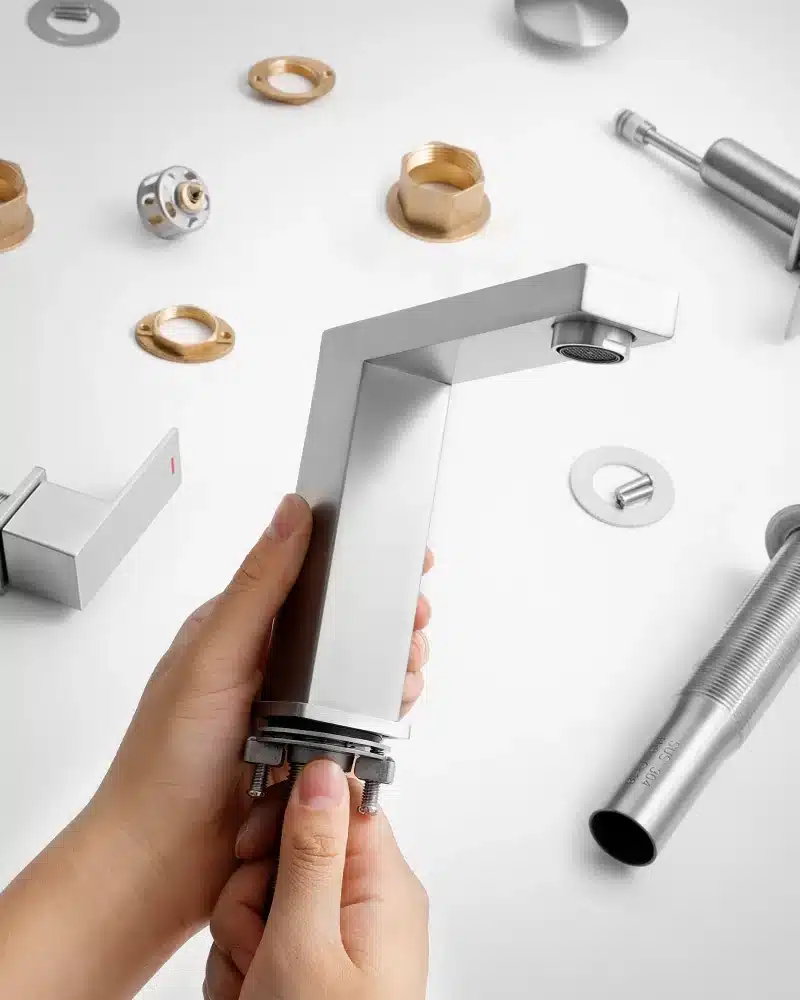
- Faucets, shut-off valves, shower arms and handheld connections — these mate to your water supply. Confirm the thread type and size on the product page before buying.
- Towel bars, hooks, rings, and shelves — no plumbing thread at all; they mount with screws and anchors (see How to Install a Towel Bar).
Tips for a leak-free threaded connection
- Wrap PTFE tape clockwise (as seen from the thread end) on the male thread, 2–3 turns — on tapered connections only.
- Hand-tighten first, then snug with a wrench — don’t overtighten tapered threads; the taper does the sealing, not brute force.
- Washer-sealed (straight-thread) connections: skip the tape, make sure the washer is seated, and tighten to firm contact.
- Turn the water back on and check for drips before closing up — per EPA WaterSense, even one drip per second wastes 3,000+ gallons a year.
FAQ
Do towel bars use NPT?
No — towel bars mount with screws or anchors. NPT is only for water connections like faucets and valves.
Why does my 1/2″ fitting measure 0.84″?
NPT sizes are nominal, not actual. Match the marked size, not the calipers.
Will a European G1/2 fitting fit US 1/2″ NPT?
Not reliably — 55° vs 60° thread angles and different pitches. Use an adapter.
What NPT size do US bathroom faucets use?
Commonly 1/2″ NPT, but confirm the specific product’s stated size.
Sources
Related: The Complete Guide to Bathroom Hardware · Are Metal Faucets Better Than Plastic? · How to Install a Towel Bar