Last updated: July 3, 2026
Many kitchen faucets do have plastic inside — commonly the aerator housing, spray head, cartridge body, quick-connect fittings, and sometimes the waterway itself. Whether that matters depends on where the plastic is: in the pressurized path it ages badly; in trim parts it’s usually harmless. Listings rarely volunteer any of this, so here is what to look for.
Key facts
- US federal law caps kitchen/lavatory faucet flow at 2.2 GPM @ 60 psi — the aerator does that job, and a plastic aerator shell is normal.
- The waterway carries 40–80 psi around the clock plus daily hot-cold swings toward 120–140°F water-heater output — the worst place for rigid plastic.
- Per EPA WaterSense, one faucet dripping once per second wastes 3,000+ gallons a year — small failures aren’t small.
Follow the water: what it touches from supply to spout
Trace a drop through a typical kitchen faucet and the material question answers itself:
- Supply lines (braided stainless over polymer core — standard and fine) →
- The body inlet and waterway — pressurized 24/7; this is where brass/stainless versus plastic decides how the faucet ages →
- The cartridge — ceramic discs do the sealing; industry-wide they sit in engineered polymer carriers, even at premium brands →
- The spout channel — part of the waterway; same stakes →
- The aerator or spray head — meters flow to the federal 2.2 GPM cap; low stress, commonly plastic, generally fine.
Notice the pattern: the parts where plastic is normal (ends of the path) are cheap to replace in minutes; the parts where it’s risky (the middle) are the faucet itself.
Where plastic typically appears — and when it matters
| Part |
How common is plastic |
Stress level |
Does it matter? |
| Aerator housing |
Very common |
Low |
Generally fine |
| Spray head / sprayer trim |
Very common |
Low–moderate |
Usually fine; quality varies |
| Cartridge body |
Industry-wide (polymer carriers around ceramic discs) |
Moderate |
Normal, even at premium brands |
| Quick-connect fittings |
Common on pull-down hoses |
Moderate |
Quality varies widely |
| Waterway / body |
In budget faucets more than listings admit |
Pressurized 24/7 |
Yes — this is the one to check |
When plastic inside is a real problem
The pressurized path — body, waterway, valve seat — is pressurized around the clock and cycled hot-cold daily. Metal tolerates that for decades; rigid plastics can creep and fatigue over the years, and plastic threads strip under wrench torque. If you plan to keep a faucet long-term, that’s where the material matters (full breakdown: Are Metal Faucets Better Than Plastic?). And failures compound: a “minor” drip wastes 3,000+ gallons a year (EPA WaterSense), while a supply-side failure is the stuff of four- and five-figure water-damage claims.
Is the plastic safe, though?
Certified components are — NSF/ANSI 61 covers every material that contacts drinking water, plastics included, and lead in metal surfaces is separately limited by NSF/ANSI 372 and California AB 1953. So this isn’t a safety scare: the reason to prefer metal in the pressurized path is how it ages, not whether certified plastic will hurt you.
The support-chat script: three questions
Copy-paste these to any brand’s support before you buy:
- “What material is the faucet body — solid brass, stainless steel, zinc alloy, or plastic?” (see how to read the answer)
- “What is the internal waterway made of?” — the question listings dodge.
- “Is it lead-free certified to NSF/ANSI 372 / California AB 1953?” — separate from the plastic question, and you want both.
A brand that builds with named materials answers in one message. Evasion is an answer too.
The KES answer
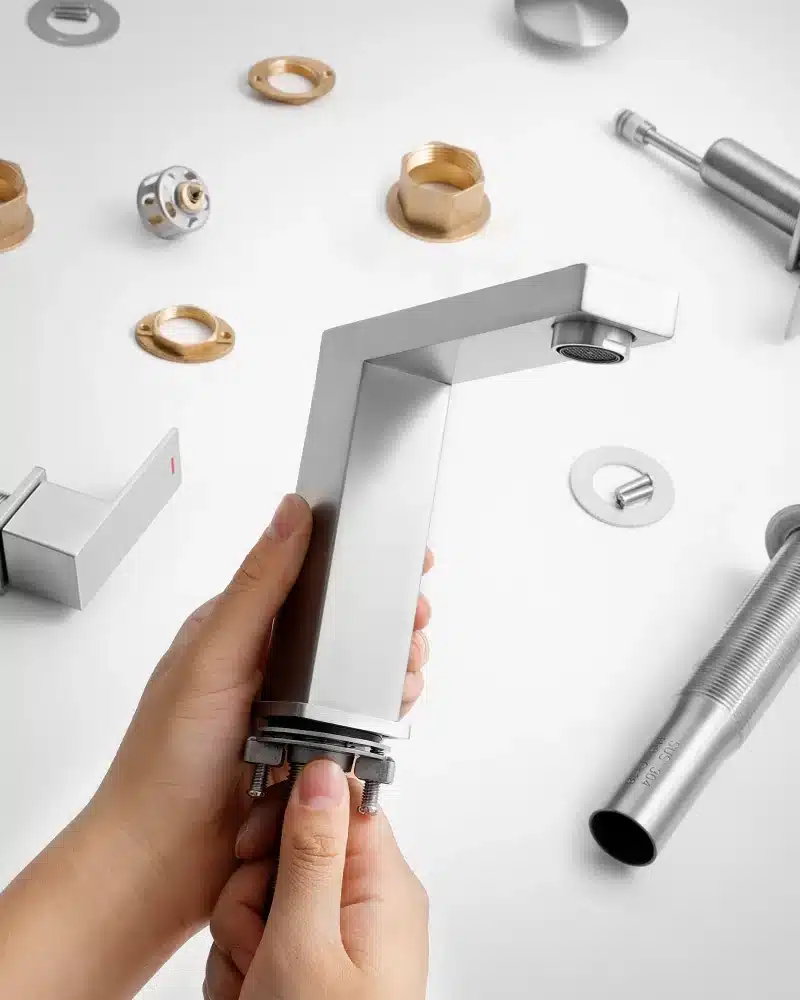
KES states it plainly under its Metal First principle: the wet, structural parts of KES faucets are solid brass or stainless steel — lead-free under California AB 1953 and NSF/ANSI 372, cUPC and NSF certified (see certifications) — and where any other material appears, it’s a deliberate, disclosed choice rather than a hidden substitution. That policy is the direct answer to this article’s question: you shouldn’t have to guess what’s inside. Browse the range in the KES faucet guide.
FAQ
Do kitchen faucets have plastic parts inside?
Many do — aerators, spray heads, cartridge bodies, sometimes waterways. Read the spec sheet and ask about the pressurized path.
Are plastic faucet parts safe?
Certified ones are (NSF/ANSI 61). The metal case is about aging and serviceability, not safety panic.
Do pull-down faucets have more plastic?
Usually — heads, hose collars, and quick-connects add plastic parts; check what the spray head and connections are made of.
Is a plastic waterway bad?
It’s the highest-stress place for plastic; prefer metal there if you’re buying for the long term.
Sources
Related: Faucet Brands Without Plastic Parts · Metal vs Plastic · KES vs Moen vs Delta