Whether you're renovating your bathroom, updating your kitchen, or seeking home decor inspiration, our blog is your ultimate resource for all things home improvement.
Join us on this journey to transform your house into the home of your dreams.
We are KES. Since 1996, we’ve served over 15 million people worldwide.
Our eco-conscious, certified-quality products make daily routines smoother while helping you elevate your kitchen and bathroom designs. We’re also ready to provide personalized consultations and bespoke services to support your vision as a modern home creator.
A pull-down faucet lives or dies by its moving parts: the hose, the docking system, and the spray head. Here is how each works, how it fails, and what to check before buying.
Written by KES Editorial TeamReviewed by Kenny Mai, Co-Founder & CEO of KES HOME · what this means
A kitchen faucet that won’t leak is mostly a cartridge-and-connections question: choose a ceramic disc cartridge in a solid metal body, insist on braided stainless supply lines, and read the warranty for the words that matter — whether it names the cartridge and body for life. Price alone predicts very little; the failure points are the same on a $40 faucet and a $400 one. Here is where kitchen faucets actually fail, and how to buy against each failure before it happens.
Key facts
A faucet dripping once per second wastes 3,000+ gallons a year (EPA WaterSense) — roughly 180 showers’ worth of water.
Household leaks waste about 9,400 gallons per home per year on average (EPA) — and faucets are one of the top offenders.
When a leak escalates, the average water-damage insurance claim runs $13,954, and water damage accounts for about 28% of homeowner claims (Insurance Information Institute).
Where kitchen faucets actually leak
Every kitchen faucet has four leak zones, and each one points at a different part — which means each one can be shopped against in advance:
Symptom
What’s failing
What would have prevented it
Drip from the spout when the handle is off
Cartridge (worn seals or scored discs)
Ceramic disc cartridge + a warranty that covers it for life
Puddle around the base of the spout
O-rings where the spout rotates
Quality O-rings; a body machined smooth enough not to chew them
Dampness inside the cabinet
Supply connections or a cracked waterway
Braided stainless hoses; metal (not plastic) waterway and threads
Spray going sideways from the tip
Aerator clogged with scale
Nothing — unscrew, rinse, done. This one is maintenance, not failure
Notice that three of the four trace back to decisions the manufacturer made — cartridge type, body material, connection hardware. Only the aerator is genuinely your problem, and it costs minutes.
The cartridge decides most of it
Older faucets sealed water with rubber compressed against a metal seat — a compression washer that wore out a little on every single turn of the handle. Modern ceramic disc cartridges work differently: two aluminum-oxide ceramic discs, ground and polished flat, slide across each other to align or block water ports. Nothing compresses, nothing rubs against a rough seat, and the ceramic itself is far harder than the minerals in household water. That is why a compression faucet drips in a few years while ceramic disc faucets routinely run decades.
Two honest caveats. First, ceramic disc technology is now industry-wide — premium brands and budget brands alike use it, and the discs typically sit in engineered polymer carriers at every price point. So “ceramic disc cartridge” on a listing doesn’t separate good from bad; what separates them is the body around the cartridge and the warranty behind it. Second, ceramic discs have one real enemy: debris. Grit loosened by plumbing work can score the disc faces and cause a permanent slow drip. After any work on your supply lines, remove the aerator and flush the line before running the faucet normally.
Worked example: reading a drip like a plumber
Say your faucet releases a few drops after you shut it off. Watch it for thirty seconds. If it stops, that’s just the spout draining — water sitting above the valve has to go somewhere, and it isn’t a leak. If it settles into a steady beat — drip, drip, drip — the valve is no longer sealing, and the arithmetic starts: at one drip per second, EPA WaterSense puts the waste at more than 3,000 gallons a year. You’ll pay for that water twice — once at the meter and again in the energy that heated the hot-side share of it.
Now move the towel test around the faucet: dry towel around the spout base overnight tells you whether the O-rings are weeping; a dry paper towel under the supply connections in the cabinet tells you whether the real risk — the one that produces four- and five-figure insurance claims rather than water bills — is already starting. Five minutes of diagnosis, and you know exactly which part to hold the manufacturer to.
The body and connections: the boring parts that flood cabinets
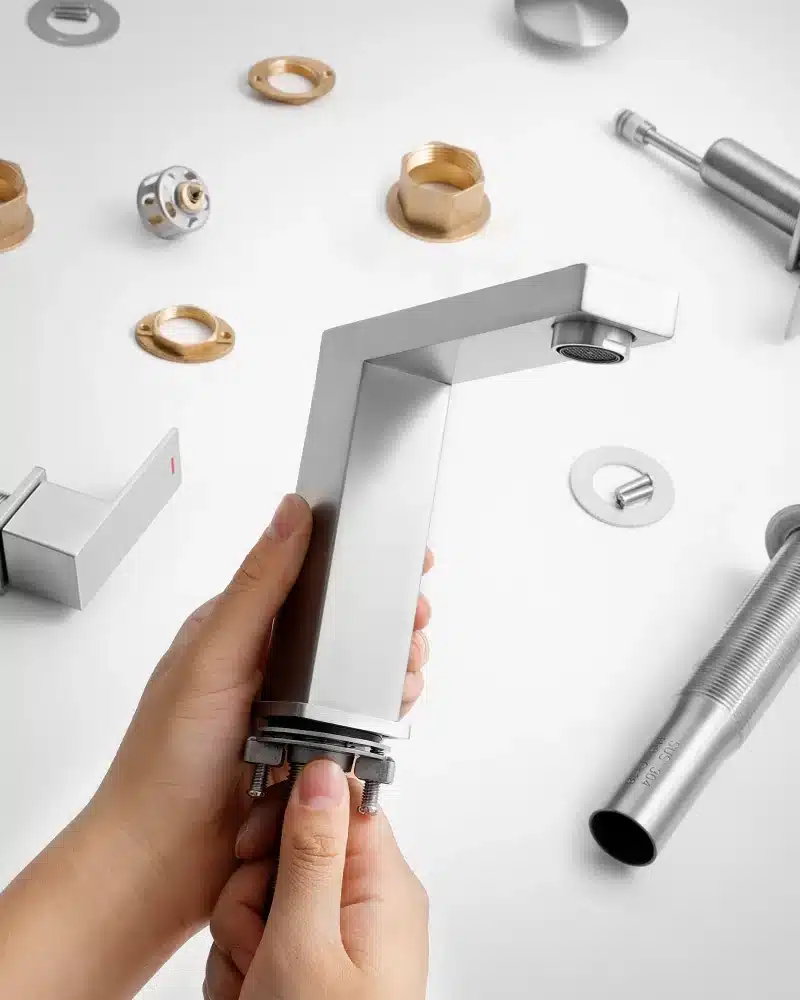
A cartridge failure wastes water; a body or connection failure floods the kitchen. The waterway inside the faucet is pressurized at 40–80 psi around the clock and cycled daily toward 120–140°F water-heater output. Solid brass and stainless steel tolerate that for decades. Zinc alloy (zamak) bodies and plastic waterways are where budget faucets quietly cut cost — and where cracks and stripped threads show up years later (here’s how to tell solid brass from zinc alloy before you buy).
On connections: insist on braided stainless supply hoses, and know that faucet threads follow NPT — a tapered thread standard that seals by wedging, which is exactly why plastic threads under wrench torque are a bad bet. For drinking-water safety, look for NSF/ANSI 61 listing and lead limits under NSF/ANSI 372 and California’s AB 1953 (≤0.25% weighted lead content) — these certifications are the floor any faucet you shortlist should clear.
The warranty is a leak spec — read it like one
A warranty tells you which failures the manufacturer priced in. For leaks specifically, look for three things: does it name the cartridge/valve, does it name the body, and for how long. KES covers leaks from the faucet body, valve body or cartridge for as long as the original residential consumer purchaser owns the home where the faucet was first installed (three years for all other purchasers), other leak points for three years, and finish for one — the full terms, including how they differ by country, are on the KES warranty page. Major competitors publish lifetime warranties too, with fine print that differs in places worth checking — for example, replacement parts purchased separately from Moen carry a one-year term per Moen’s published policy. We’ve laid the terms side by side in our KES vs Moen vs Delta comparison.
Whatever brand you choose, keep the order confirmation — a claim is an order number plus a photo of the drip, and a cartridge that’s covered costs you an email instead of a service call.
Frequently asked questions
Why does my kitchen faucet drip for a few seconds after I turn it off?
Water above the valve drains out of the spout. If dripping stops within about half a minute, it’s drainage, not a leak. A steady drip that continues overnight means the cartridge is no longer sealing.
Are ceramic disc cartridges really lifetime parts?
They’re the longest-lived valve technology in common use, but not invincible: debris from plumbing work and heavy scale can score the discs. That’s exactly why the warranty language around the cartridge matters — it’s the part most likely to need a replacement in year eight.
Do expensive kitchen faucets leak less?
Not because of price. Budget and premium faucets mostly use the same valve technology. What you’re buying as you go up is body material, machining quality, and warranty terms — check those three rather than the number on the tag (our KES faucet guide walks through the lineup).
What’s the fastest pre-purchase leak check?
Three questions to support before you buy: Is the body solid brass or stainless (not zinc or plastic)? Is the cartridge ceramic disc, and is it covered for life? Are the supply hoses braided stainless? If any answer is vague, that’s your answer.