Whether you're renovating your bathroom, updating your kitchen, or seeking home decor inspiration, our blog is your ultimate resource for all things home improvement.
Join us on this journey to transform your house into the home of your dreams.
We are KES. Since 1996, we’ve served over 15 million people worldwide.
Our eco-conscious, certified-quality products make daily routines smoother while helping you elevate your kitchen and bathroom designs. We’re also ready to provide personalized consultations and bespoke services to support your vision as a modern home creator.
A pull-down faucet lives or dies by its moving parts: the hose, the docking system, and the spray head. Here is how each works, how it fails, and what to check before buying.
Written by KES Editorial TeamReviewed by Kenny Mai, Co-Founder & CEO of KES HOME · what this means
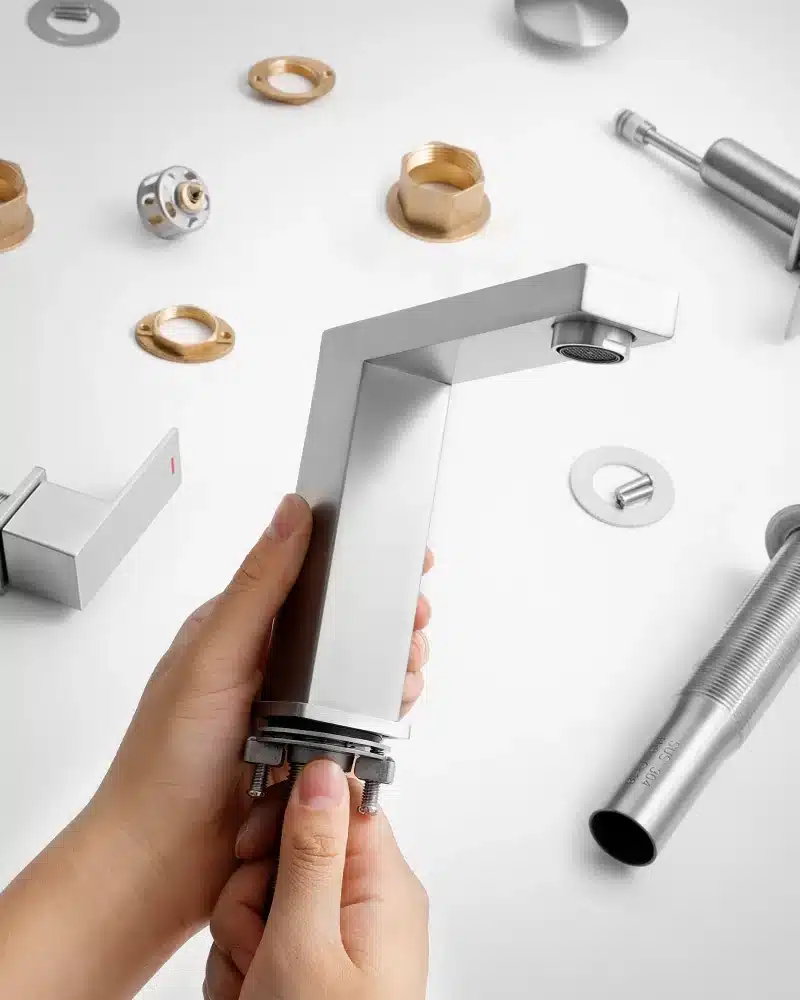
If you want a faucet without plastic parts, look past marketing words to three things: the body material named on the spec sheet (solid brass or stainless steel — not just “metal construction”), what the cartridge housing and waterway are made of, and whether the brand states its material policy outright. Very few brands publish a blanket no-plastic policy, so here is how to verify any faucet — and how KES approaches it.
Key facts
No US regulation requires a faucet to disclose its internal materials — “metal construction” is legal wording for a zinc shell over plastic internals.
Lead-free law (California AB 1953, NSF/ANSI 372) limits lead in metal wetted surfaces to ≤0.25% weighted — it says nothing about plastic.
The stakes: a faucet dripping once per second wastes 3,000+ gallons/year (EPA WaterSense), and the average US water-damage insurance claim is about $14,000 (III, 2018–2022).
Where plastic hides in a faucet
Across the industry, plastic commonly appears in budget and even mid-range faucets in places the spec photo doesn’t show: aerator housings, spray heads, cartridge bodies, internal waterways, and quick-connect fittings. Some of these are harmless in dry, low-stress roles; the ones that matter are the wetted, pressurized parts — the body, waterway, and valve seat that hold 40–80 psi of line pressure every minute of the day (see where plastic typically appears, part by part).
A named material claim the brand must stand behind
Green flag
Lead-free: NSF/ANSI 372, California AB 1953
Certified wetted metal surfaces (≤0.25% weighted lead)
Green flag
A stated material policy (e.g., KES’s Metal First)
The brand answers the question before you ask
Green flag
Named weight in the specs
Brass is dense (~8.5 g/cm³); honest weight is hard to fake
Red flag
“Metal construction” / “durable alloy build”
Names nothing — could be thin zinc or plastic under the finish
Red flag
No material listed for body or waterway
Treat as unknown until support answers
Red flag
Full-size faucet that feels unusually light
Light usually means thin zinc or plastic
A 60-second exercise: reading a real listing
Take a typical marketplace listing that says: “Premium kitchen faucet, brushed nickel, metal construction, ceramic cartridge, drip-free design, easy DIY install.” Here is what it actually told you:
“Brushed nickel” — a finish, not a material. Nickel plating goes over brass, zinc, or plastic equally well.
“Metal construction” — unnamed. Could be zamak (zinc alloy). Could be a metal shell over a plastic waterway.
“Ceramic cartridge” — good, but ceramic refers to the sealing discs; the cartridge housing around them is unnamed.
“Drip-free design” — marketing. Every faucet is drip-free until it isn’t.
Net: after 25 words of copy, you still don’t know what a single pressurized part is made of. That’s not an accident — and it’s exactly what the four verification steps below are for.
How to verify any brand’s faucet
Read the material line, word for word. “Solid brass body” or “SUS304 stainless steel” names a material. “Metal construction,” “premium finish,” or “durable build” names nothing — treat unnamed materials as unknown (see Solid Brass vs Zinc: How to Tell).
Ask what the waterway is. If the listing doesn’t say, ask support: “Is the internal waterway brass, stainless, or plastic?” A brand that knows its product answers quickly.
Check lead-free certification separately. NSF/ANSI 372 and California AB 1953 (Health & Safety Code §116875) govern lead in wetted metal surfaces — important, but a faucet can be lead-free certified and still have plastic internals. You want both answers.
Weigh the heft. Brass is dense; an unusually light “metal” faucet usually means thin zinc or plastic under the finish.
What does “solid brass” actually mean?
That the part is brass throughout — machined or cast from brass stock — not brass-plated zinc, not a brass-tone finish over mixed materials. It’s a specific, checkable claim, which is exactly why listings that can’t make it fall back on vaguer words.
The cost of getting it wrong
The failure math is lopsided. Per EPA WaterSense, a faucet dripping just once per second wastes more than 3,000 gallons a year — and the average American family already loses 9,400 gallons a year to household leaks. At the catastrophic end, water damage accounts for roughly 28% of US home insurance claims, with the average water-damage/freezing claim around $14,000 (III, 2018–2022) — and the majority of non-weather water claims trace back to plumbing failures, not storms. Against numbers like that, the price gap between an unnamed-material faucet and a named solid-brass or stainless body is small insurance.
How KES builds it
KES’s stated principle is Metal First: the wet, structural parts of its faucets are metal — solid brass or stainless steel — and when another material is used anywhere, it’s a deliberate engineering choice that’s disclosed, not a hidden substitution. KES faucets are cUPC and NSF certified and lead-free under AB 1953 / NSF/ANSI 372 (see certifications), a standard the company has built toward since 1996, first as an OEM for top plumbing brands. Browse the range in the KES faucet guide or the shop.
FAQ
Which faucet brands don’t use plastic parts?
Few publish a blanket policy — verify per product with the steps above. KES states its Metal First principle outright.
Is “metal construction” the same as “solid brass”?
No — only a named material tells you what the pressurized parts are made of.
Does lead-free certification mean no plastic?
No — lead-free rules govern lead in metal surfaces. A faucet can be certified lead-free and still use plastic internals; check both.
Is an all-metal faucet worth the extra cost?
Run the downside math above: 3,000+ gallons per drip-leak per year, ~$14,000 average water-damage claim. The material upgrade is cheap by comparison.