Last updated: July 5, 2026
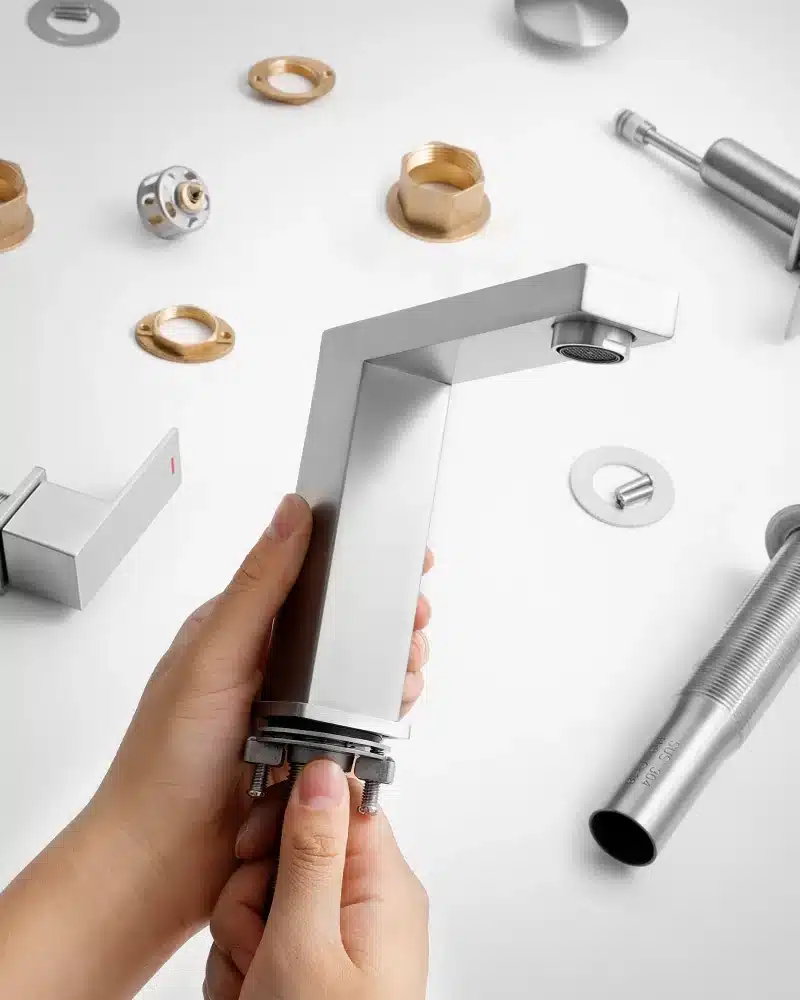
A “best” solid brass kitchen faucet comes down to three checks: the body and waterway are genuinely solid brass (not “brass-plated” or “brass construction” over zinc), the brass is certified low-lead (NSF/ANSI 372, California AB 1953), and the warranty names the body and cartridge — not just the finish. Brand names matter less than those three lines of fine print. Here is how to read a faucet listing like a metallurgist, without owning a lab.
Key facts
- Solid brass is roughly 25–30% denser than zinc alloy (about 8.5 vs 6.7 g/cm³) — weight on the spec sheet is the cheapest lie detector available.
- Brass melts around 900°C vs zamak’s ~385°C and holds noticeably higher tensile strength — the difference shows up in thread durability and decades-later serviceability, not on day one.
- US law caps faucet wetted surfaces at ≤0.25% weighted lead content (California AB 1953, Health & Safety Code §116875, verified via NSF/ANSI 372) — certified low-lead brass is a legal baseline, not a premium feature.
Why solid brass earns its price in a kitchen faucet
The parts of a faucet you never see do the hard work: the body and waterway sit pressurized at 40–80 psi around the clock and swing daily toward 120–140°F water-heater output. Brass tolerates that for decades. Its threads take wrench torque without stripping, its walls don’t creep under sustained pressure the way rigid plastics can, and twenty years from now a plumber can still unscrew the connections instead of cutting them out. Zinc alloy (zamak) looks identical under the finish and costs a fraction — which is exactly why it’s what budget faucets quietly use (our solid brass vs zinc guide covers the metallurgy in depth).
One honest caveat before the brass evangelism goes too far: 304 stainless steel is an equally legitimate premium choice — different chemistry, same durability class. KES builds in both. The metal to avoid in the pressurized path isn’t “not brass”; it’s unidentified zinc alloy and plastic sold with vague wording.
Worked example: outing a fake from the spec sheet
Take two “brass” pull-down faucets side by side. Listing A says “solid brass body” and lists shipping weight at 5.8 lbs. Listing B says “brass construction,” weighs 3.1 lbs, and the word “body” never appears near the word “brass.” Run the logic: a pull-down faucet’s spout and body are most of its metal; solid brass at ~8.5 g/cm³ simply cannot produce a 3-pound faucet of that size. Listing B is almost certainly a zinc body with brass fittings — legal to sell, misleading to imply. Two more forensic tells:
- “Brass construction” / “brass finish” / “metal construction” are weasel phrasings. The honest sentence names the part: “solid brass body and waterway.”
- A magnet proves nothing — brass and zinc alloy are both non-magnetic. Weight and wording are your instruments, not fridge magnets.
The lead question, answered honestly
Traditional brass alloys contain a little lead for machinability, which is why the law stepped in: since 2010 California’s AB 1953 (now effectively the national baseline via the federal Safe Drinking Water Act amendment) caps wetted-surface lead at a 0.25% weighted average, verified by NSF/ANSI 372. Certified low-lead brass is safe for drinking water — this is settled engineering, not a marketing claim. What you should do as a buyer is simply confirm the certification is stated: look for cUPC, NSF/ANSI 61, and NSF/ANSI 372 marks on the listing or spec sheet. A “solid brass” faucet with no certification language is a bigger red flag than any zinc faucet with honest paperwork.
Solid brass vs the alternatives
| Body material |
Corrosion behavior |
Thread/torque strength |
Relative weight |
The catch |
| Solid brass |
Excellent; DZR (dezincification-resistant) grades best |
Excellent |
Heaviest |
Price; verify low-lead certification |
| 304 stainless steel |
Excellent; self-healing passive layer |
Excellent |
Heavy |
Fewer finish options at some brands |
| Zinc alloy (zamak) |
Fine until finish or plating fails; dezincification risk |
Weak — threads strip under wrench torque |
~25–30% lighter |
Often sold under “brass construction” wording |
| Plastic waterway hybrids |
N/A (aging, not rust) |
Weakest |
Lightest |
Creep and fatigue in the pressurized path (where plastic hides) |
The rest of the faucet still matters
A solid brass body with a bad valve still drips. Whatever the body metal, confirm the ceramic disc cartridge and read the warranty as a leak spec — does it name the cartridge and body for life, or just the finish? Our guide to faucets that won’t leak walks the full checklist, and the KES vs Moen vs Delta comparison puts the big warranties side by side. KES’s own terms — lifetime on main-body and cartridge leaks for the original residential owner — are published on the warranty page, and the lineup is in the KES faucet guide.
Frequently asked questions
How can I tell if a faucet is really solid brass?
Three checks: the listing names the body and waterway as solid brass (not “brass construction”); the weight is consistent with brass density (a full-size kitchen faucet under ~4 lbs deserves suspicion); and the maker answers directly when support is asked “is the body solid brass, zinc alloy, or plastic?”
Is brass with lead in it dangerous?
Certified low-lead brass (NSF/ANSI 372, AB 1953 compliant, ≤0.25% weighted lead) is the legal standard for US drinking-water faucets and is safe. The thing to avoid is uncertified hardware with no compliance language at all.
Is solid brass better than stainless steel?
They’re durability peers with different personalities: brass is heavier, easier to machine to tight tolerances, and traditional; 304 stainless resists corrosion with a self-healing passive layer and skips the lead question entirely. Either beats unidentified zinc. Choose by finish, price, and warranty rather than by the alloy alone.
Why are solid brass faucets more expensive?
Raw material (copper is costlier than zinc), machining time, and weight-driven shipping. You’re paying for the pressurized path to be metal that survives decades — which is also why the warranty behind it should be long enough to prove the maker believes it.
Sources
- California DTSC — Lead in Plumbing (AB 1953)
- Copper Development Association — brass in plumbing applications (alloy properties, dezincification)
- NSF/ANSI 61 & 372 — drinking water system components