

Last updated: July 5, 2026
For bathroom and kitchen hardware, 304 is the better choice; 201 is cheaper but rusts sooner in humid, chloride-exposed settings. They look identical in the store, so the difference only shows up months later. Here is what separates them and when each makes sense.
The core difference: nickel vs manganese
Both are austenitic stainless steels with ~16–18% chromium, so both form a passive protective layer. The difference is what stabilizes it:
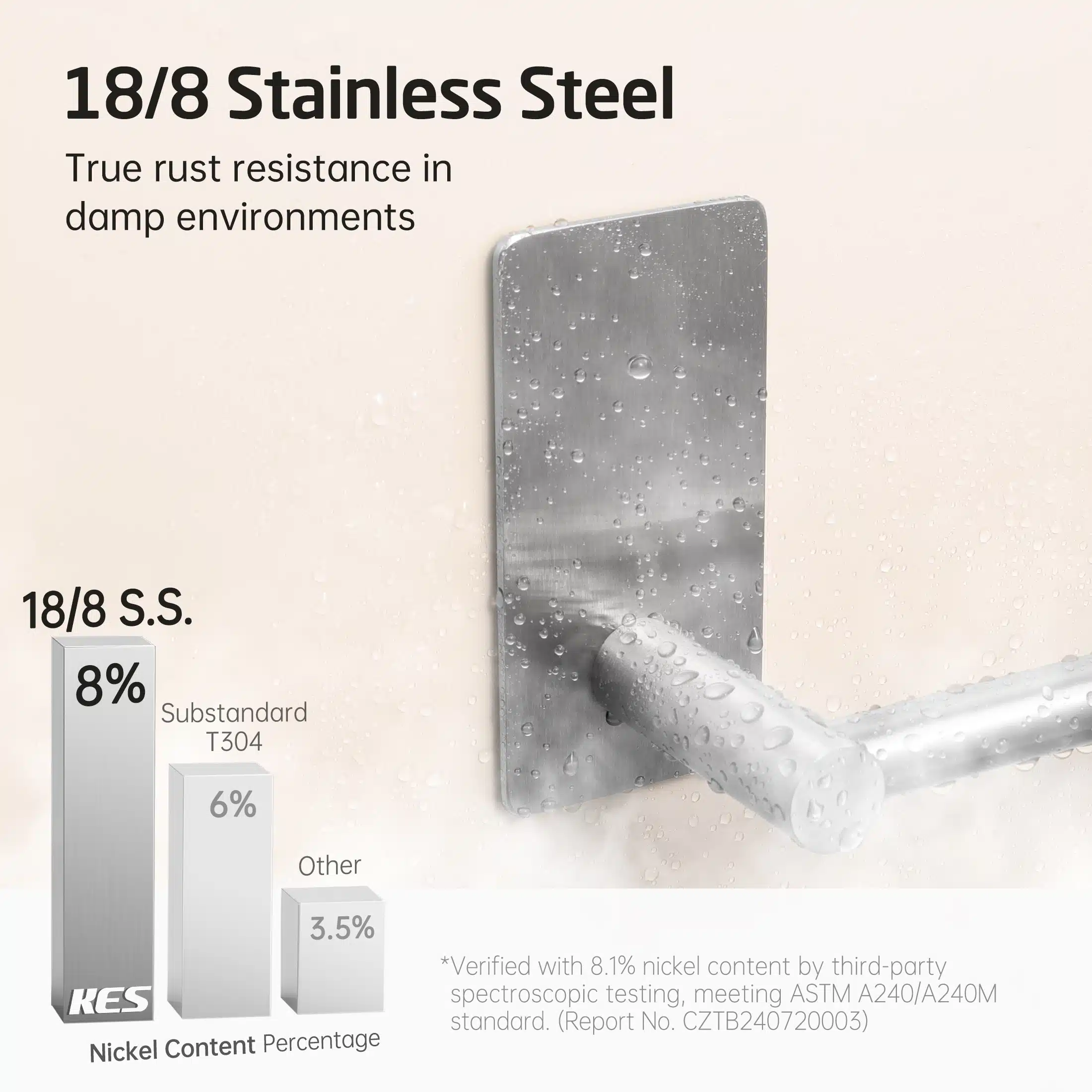
- 304 uses ~8% nickel — a stable, durable passive layer and better all-round corrosion resistance.
- 201 replaces most of the nickel with manganese and nitrogen to cut cost (nickel is the expensive ingredient), typically only ~1–5% nickel.
In a dry indoor setting the gap is small. In a wet bathroom it grows.
Side-by-side
| Property | 304 | 201 |
|---|---|---|
| Nickel | ~8% | ~1–5% |
| Corrosion resistance (humid) | Better | Lower — surface rust over time |
| Cost | Higher | Lower |
| Best use | Wet/structural, long-life | Dry, indoor, cost-driven |
How to tell them apart
Day one they look nearly identical, but there are signals:
- The listing — and whether it states a composition. A grade name (“304,” “SUS304”) is a label; a stated composition — “18/8,” i.e. 18% chromium and 8% nickel — commits to the nickel, which is the expensive ingredient and exactly where costs get cut. Prefer hardware that states its composition (KES lists its steel as 18/8). A vague “stainless steel” claim at a suspiciously low price is often 201.
- A rough visual tell. 304 tends to look brighter and cleaner; 201, with less nickel and more manganese, can read slightly darker — a touch grayish or faintly yellowish. Not definitive, but a dull gray cast is a warning sign.
- Long-term behavior. 201 tends to show faint surface rust (“tea staining”) first at welds, edges, and where water pools.
Cost vs long-term value
201 wins on upfront price — that’s the whole reason it exists. But for a wet, multi-year fixture, 304’s corrosion resistance usually makes it the better long-term value: you’re buying years of finish life and fewer rust headaches. Pay the 304 premium on the parts that get wet. And when you compare listings, look for the composition claim: “18/8” tells you what is in the steel; a bare grade name does not.
Frequently Asked Questions
Is 201 stainless steel safe?
It’s structurally fine for dry uses; the concern in bathrooms is corrosion and appearance, not safety.
Can I tell 304 from 201 with a magnet?
No — both are weakly magnetic at best; a magnet test is unreliable for distinguishing them.
What does “18/8” mean on a product page?
18% chromium and 8% nickel — the composition that defines 304. A maker that states 18/8 is declaring its nickel content rather than only using the grade name, and nickel is the number that predicts how the steel holds up in a humid bathroom. KES states 18/8 for its steel parts.
Is 304 worth the extra cost?
For wet bathroom and kitchen parts, yes — longer finish life and less rust.
Further reading
Further reading: is 304 stainless good for bathrooms and why KES uses SUS304.